


Engineering Light: The Intricate Glass Block Manufacturing Process
In an age where sustainability meets aesthetic ambition, the glass block manufacturing process has transformed these modular units from industrial utility into architectural artistry. Yet their true magic lies in a century-old process refined through modern engineering. At Luxcrystello Crystal, we master this alchemy of sand and science, creating precision-engineered glass blocks that shape light itself.
Understanding the Glass Block Manufacturing Process: From Raw Clarity to Engineered Brilliance
Phase 1: Raw Material Alchemy—The Foundation of Clarity
Glass blocks begin as a meticulously calibrated blend of natural and recycled materials:
| Material | Percentage | Function | Quality Standard |
|---|---|---|---|
| Silica Sand | 70% | Primary structural component | Iron content <0.015% to prevent discoloration |
| Soda Ash | 18% | Lowers melting temperature | Reduces energy use by 30% |
| Limestone | 10% | Enhances chemical durability | Weather-resistant properties |
| Recycled Cullet | 25-30% | Sustainable filler | Cuts CO₂ emissions by 5% per ton |
Critical Control: Grain size distribution (100-500μm) ensures homogeneous melting and consistent clarity throughout the glass block manufacturing process.
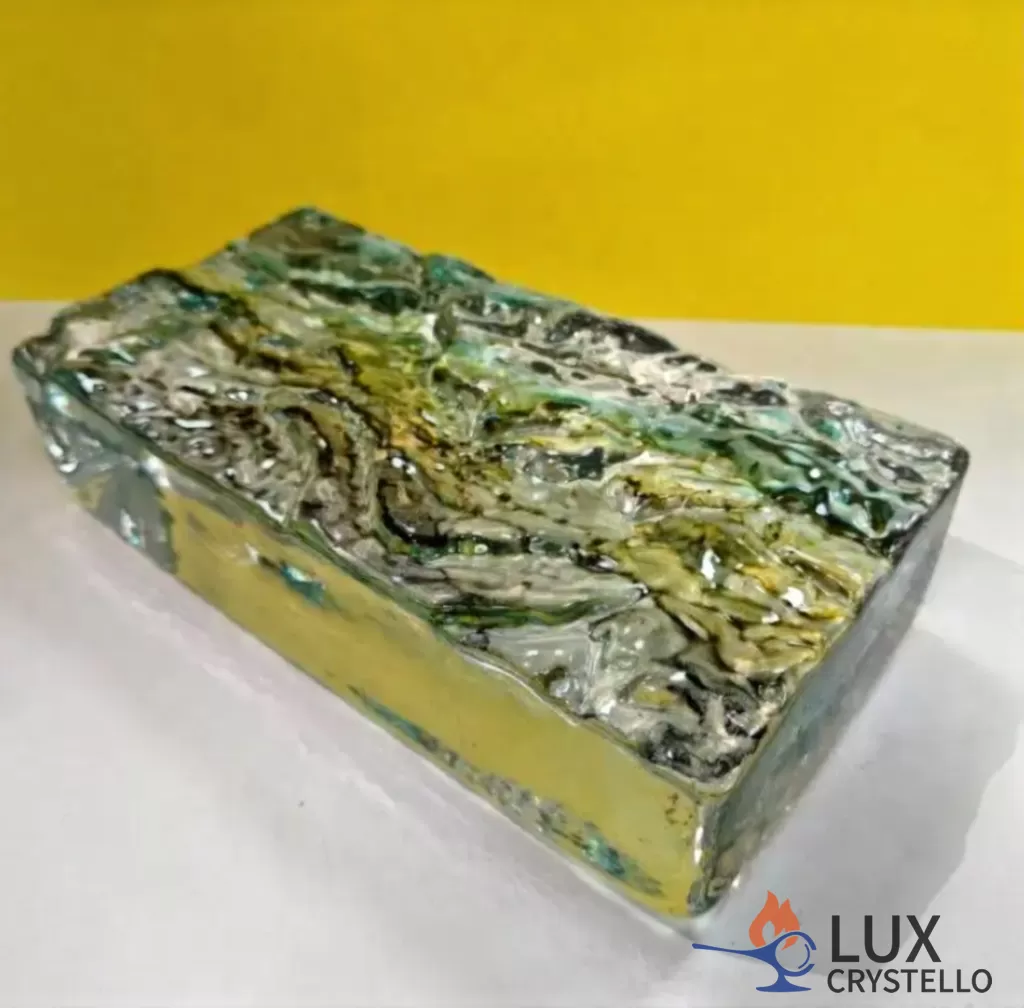
Phase 2: Melting & Refining – Thermal Engineering at Its Core
Inside massive regenerative furnaces measuring 30m x 10m, the transformation begins:
- Batch Feeding: Raw materials enter at 1,200°C, reaching 1,550°C in the melting zone
- Refining Process: Molten glass held 24+ hours for fine bubble removal
- Quality Control:
- Boron nitride stirrers homogenize viscosity
- Temperature gradients ≤2°C prevent cord defects
- Emission Control: Electrostatic precipitators capture 99.8% of particulate emissions
This stage represents the heart of the industrial glass production where raw materials achieve their translucent properties.
Phase 3: Forming – Precision in Motion
The glass forming techniques divide into two primary methods:
Method A: Press-and-Blow (80% of blocks)
- Shearing: IR sensors cut 1.2kg “gobs” (±5g tolerance)
- Pre-Molding: Tungsten-carbide molds shape half-blocks at 1,050°C
- Blowing: 8-bar compressed air expands glass to final dimensions
- Demolding: Robotic arms transfer blocks to annealing lehr
Method B: Centrifugal Casting (Textured/Specialty Blocks)
- Molten glass poured into spinning graphite molds (200-500 RPM)
- Creates wave, prism, or diamond patterns for architectural glass blocks
Phase 4: Annealing – The Silent Art of Stress Relief
The glass annealing process is critical for structural integrity:
| Stage | Temperature | Duration | Purpose |
|---|---|---|---|
| Heating | 650°C | 45 min | Uniform temperature distribution |
| Soaking | 550°C | 90 min | Stress relaxation |
| Slow Cooling | 550°C→450°C | 4 hours | Controlled crystal formation |
| Rapid Cooling | 450°C→300°C | 2 hours | Setting final structure |
| Final Cooling | 300°C→70°C | 3 hours | Room temperature adaptation |
| Quality Hold | 70°C | 30 min | Final inspection readiness |
Phase 5: Sealing & Inspection – Where Precision Meets Perfection
The final stage ensures every block meets exacting standards:
- Infrared Fusion: Halves aligned and heated to 800°C, fused in 90 seconds
- Vacuum Testing: 0.5-bar vacuum applied; bubble streams indicate leaks (reject rate <0.1%)
- Laser Scanning:
- Dimensional tolerance: ±0.3mm
- Defect detection: ≥0.15mm inclusions
This rigorous quality control process guarantees that every architectural glass block performs flawlessly in construction applications.
The Future Cast in Glass: Innovation Meets Tradition
The glass block manufacturing process stands as a testament to industrial poetry, where geology, thermodynamics, and robotics converge to shape light itself. Modern glass blocks embody the marriage of industrial precision and natural light – a testament to how human ingenuity harnesses the earth’s elements to shape luminous spaces.
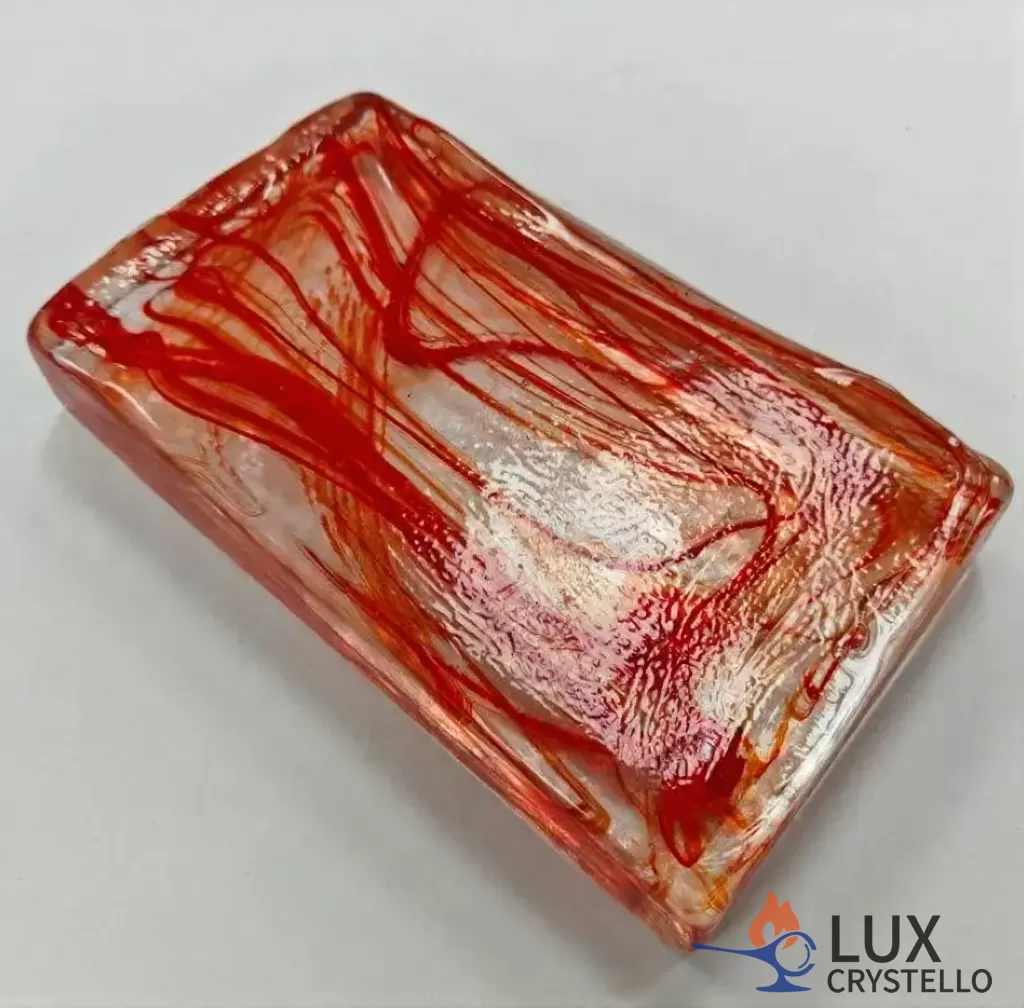
Luxcrystello Crystal: Beyond Standard Blocks – Your Vision, Perfected
While the standard glass block manufacturing process sets the foundation, Luxcrystello Crystal transforms this legacy through revolutionary innovations:
“Luxcrystello’s chromatic blocks didn’t just meet our spectral design needs—their R&D team engineered a new glass composite to achieve our impossible amber gradient.”
– Fiona Zhang, Interior Design Company Manager, Shanghai
Discover our advanced glass block solutions that push the boundaries of conventional architectural glass manufacturing. From custom optical properties to integrated smart technologies, Luxcrystello delivers precision-engineered transparency for tomorrow’s architecture.
Contact our engineering team to discuss how our innovative glass manufacturing can bring your architectural vision to life with unmatched clarity and durability.